
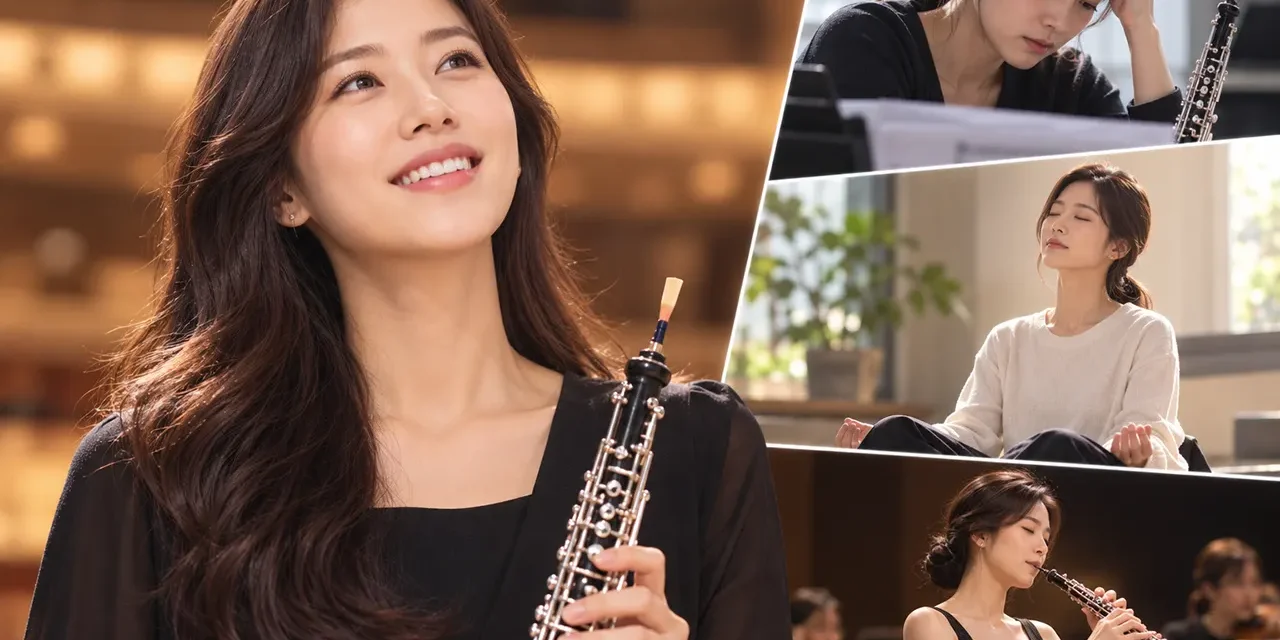
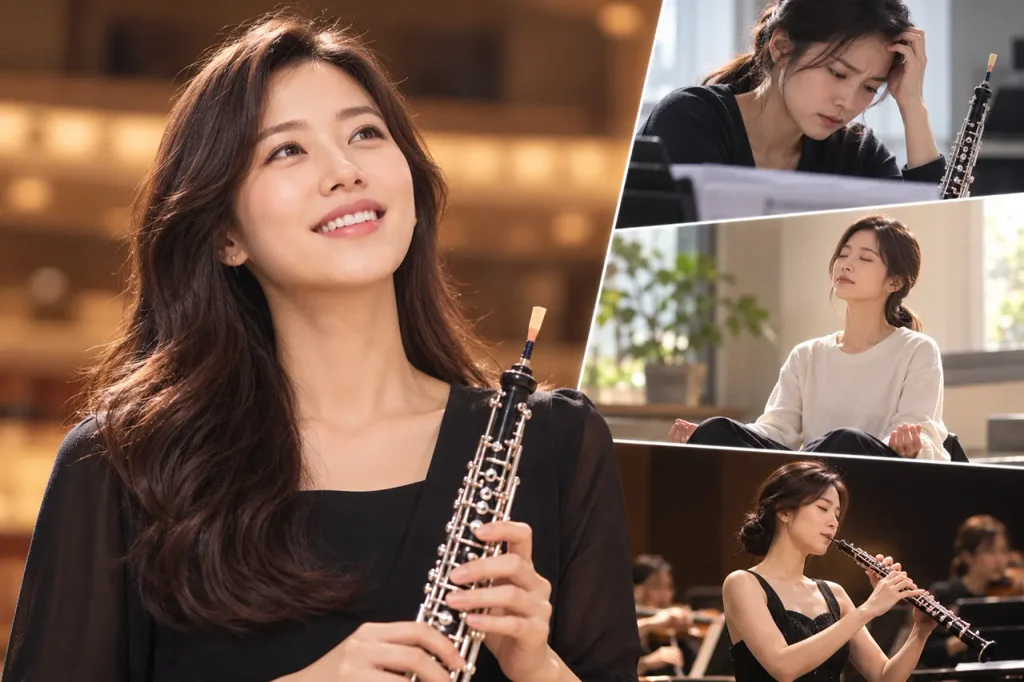
Ji Hye S. is a highly respected oboist. After studying in Germany, she returned to Korea to perform as a guest principal oboist for various orchestras and chamber ensembles, while also teaching at the Korea National University of Arts and Kyungpook National University.
Her former professor, Yoon Jung Lee, once described her with deep admiration: “She has outstanding musicality. But above all, what is most impressive is her ability to maintain calmness and remain unshaken.”
To the audience, Ji Hye appears to be a picture of effortless grace. But she will be the first to admit that this steady calmness was not a natural talent—it was a hard-won victory. This is the story of how a brilliant musician, once paralyzed by the crushing pressure of competition and the need for approval, used meditation to let go of her deepest attachment and find true artistic freedom.
The Crushing Weight of the Tuning Note
In an orchestra, the oboe holds a terrifying responsibility: it gives the tuning note. When the oboist plays the “A” note, every other instrument tunes itself to that single sound. Just by hearing that one note, the entire orchestra—and the audience—can immediately gauge the oboist’s skill level. If the pitch is even slightly off, the entire symphony can fall apart.
For Ji Hye, whose mother majored in piano and immersed her in classical music from childhood, a life in music looked elegant on the outside. In reality, it was an endless, grueling series of competitions, entrance exams, and high-stakes auditions.
Because she hated losing and was highly sensitive, she lived under constant, suffocating stress. She suffered from chronic indigestion. Because the oboe is a wind instrument, every breath directly reveals the performer’s emotional state; if her mind was unsettled, it showed immediately in her playing. Although she loved the applause and recognition, she was rarely truly happy.
A Crisis of Confidence Abroad
In her second year of college, Ji Hye tried meditation, initially planning to practice for just a week. To her surprise, as she emptied her mind, her chronic indigestion vanished, and her performance skills naturally improved.
However, her ultimate test came in 2007 when she moved to Germany to study at the State University of Music and Performing Arts Mannheim. Back in Korea, she had always been confident in her talent. But in a foreign environment with a language barrier and fierce international competition, her self-esteem plummeted. She suddenly felt like she was nothing.
During this dark period of burnout and self-doubt, the meditation center in Paris became her sanctuary. Although it was a three-hour train ride away, the warm community of Korean professors, office workers, and international students provided a safe space for her to discard her mental burdens. Through their support, she regained the courage to face her grueling studies in Germany.
The Epiphany: Letting Go of the Instrument
It was during one of these deep meditation sessions that Ji Hye realized she was holding onto something massive inside her mind: the oboe itself.
She could not imagine who she was without her instrument. Her confidence, her identity, and the praise she received were all entirely dependent on the oboe. She realized this enormous attachment was actually a prison. Because the oboe had become her entire identity, she constantly pressured herself to perform perfectly. She was terrified of failing, because failing meant she might be ignored or deemed worthless.
“I realized I was no longer playing because I loved music,” she confesses. “I was playing because I was afraid.”
For an oboist, the reed—the vibrating piece of wood that transfers breath into the instrument—is so vital that performers spend hours carving them by hand. The tone of the instrument changes drastically depending on the mind and heart of the person shaping the reed. Ji Hye knew that to truly elevate her sound, she had to let go of her desperate attachment to the oboe.
For days, she intensely discarded her attachments to music, fame, and the desperate need for love and recognition. When she finally released it in her heart, the feeling of liberation was indescribable.
When the Mind is Empty, Everything Can Be Contained
“At first, it feels like discarding everything means losing everything,” Ji Hye explains. “But in reality, the world gives back something far greater.”
Only after overcoming herself was she finally able to truly enjoy music again. Performing on stage changed completely. Instead of playing inside the narrow, anxious world of “Ji Hye,” she began seeing music from a much broader perspective. New ideas for expression flowed effortlessly. She was no longer playing to beg the audience, “Please notice how well I play.” She was simply immersing herself in the present moment, allowing the music to flow naturally like water.
Today, she understands the profound truth: “Only when nothing is inside can everything be contained.”
Ji Hye S.’s 3 Insights for Performers and Professionals
1. Your Identity is Not Your Profession “When you tie your entire self-worth to your job, your instrument, or your art, you become paralyzed by the fear of failure. When I realized I was more than just an oboist, the desperate pressure disappeared, and true freedom took its place.”
2. Stop Performing for Approval “I used to play music entirely out of fear—afraid that if I wasn’t perfect, people would ignore me. When you stop obsessing over other people’s evaluations, you can finally enjoy the process and immerse yourself in the work.”
3. An Empty Mind Creates Ultimate Focus “Many performers are so nervous they have to take anxiety medication just to stand on stage. But when you use meditation to clear the endless chain of distracting thoughts, your concentration peaks. You can fully use your abilities only when your mind is empty.”
