
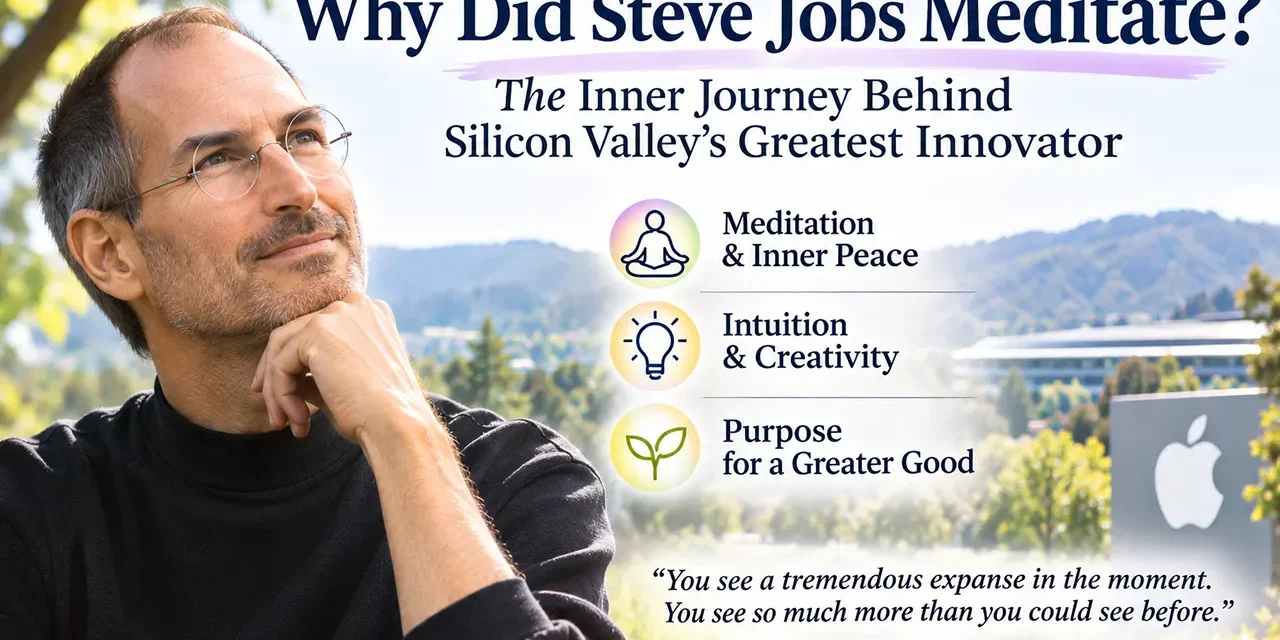
Steve Jobs fundamentally altered the trajectory of the 21st century. By seamlessly weaving together art, technology, and human experience, he created products that redefined how we live. The iPod transformed how we consume music; the iPhone put a supercomputer, camera, and communication hub into our pockets; and the iPad completely reimagined the landscape of digital media.
Jobs didn’t just analyze market trends—he anticipated what humanity would want before they even knew it themselves. Yet, the ultimate symbol of cutting-edge, fast-paced Silicon Valley technology harbored a deeply grounding secret: he was a dedicated practitioner of meditation.
During the early, chaotic days of Apple, Jobs would regularly meditate at home for an hour before heading into the office. But what drove this relentlessly driven innovator to sit in stillness? What was he searching for?
The Search for Identity and Inner Peace
To understand Jobs’ dedication to meditation, we have to look at his beginnings. Born in 1955 and raised in the San Francisco Bay Area by his adoptive parents, Paul and Clara Jobs, Steve was a highly sensitive youth. Around the age of sixteen, discovering the reality of his adoption triggered a deep existential crisis. According to his college friend, Daniel Kottke, Jobs had “a hole in his heart, and he was trying to fill it.”
During the 1960s and 70s, the Bay Area was a melting pot of counterculture, spirituality, and Zen Buddhism. Wandering in search of his true identity, Jobs naturally gravitated toward these progressive ideas. By the time he entered college in 1972, he was devouring books on enlightenment, even setting up a dedicated meditation room draped in Indian tapestries and filled with incense. He strongly believed there was a profound truth beyond the everyday reality we see, and he was determined to find it.
Discovering Zen: Cultivating the Mind
In 1974, Jobs dropped out of college and took a seven-month pilgrimage to India. He wasn’t just being a tourist; he was desperately seeking enlightenment to understand who he was and what his place in the world should be.
Upon returning to California, he officially began formal Zen practice at the Los Altos Zen Center, training under Zen master Kobun Chino, who became his lifelong spiritual mentor. Jobs didn’t treat meditation as a passing phase; he embraced it with intense devotion. Years later, he beautifully summarized how this practice transformed his mind:
“If you just sit and observe, you will see how restless your mind is. If you try to calm it, it only makes it worse, but over time it does calm, and when it does, there’s room to hear more subtle things. That’s when your intuition starts to blossom and you start to see things more clearly and be in the present more. Your mind just slows down, and you see a tremendous expanse in the moment. You see so much more than you could see before.”
Making a Dent in the Universe
In Zen philosophy, true enlightenment is realizing that you are intrinsically connected to the rest of the universe—that you are not a separate, isolated entity. This realization naturally shifts a person’s mindset from creating just for oneself, to creating for the greater good of humanity.
This philosophy became the heartbeat of Apple. When launching the “Lisa” computer project, Jobs famously rallied his team by saying, “Let’s make a dent in the universe. Let’s make something truly great and shake up the universe!”
Jobs’ ultimate goal was never merely to maximize profits. He wanted to build an enduring company that motivated people to create magnificent things. He viewed great engineers and great artists as identical—both were simply looking for the perfect medium to express their deepest feelings and add something meaningful to the flow of human history.
Embedding “Deep Humanity” into Technology
Jobs believed that the reason people truly loved Apple products was because there was a “deep humanity” flowing through them. He wanted his engineers to embed not just circuits and glass, but a profound spirit into everything they built.
True insight means exactly what the word implies: to look in. Jobs’ remarkable external achievements were the direct result of his relentless inward journey. By taking the time to empty his mind, discard his anxieties, and reflect on his true self, he unlocked an unparalleled level of intuition and creativity.
Here at San Jose Meditation, we are surrounded by the fast-paced innovation of Silicon Valley. But just like Steve Jobs discovered, true clarity, purpose, and groundbreaking ideas do not come from a restless, cluttered mind. They come from stillness.
If you are searching for your own sense of identity, hoping to reduce stress, or simply looking to unlock your highest potential, the journey begins by looking within. We invite you to discover the power of clearing your mind with us at San Jose Meditation today.
